
AI and NLP for Automating ICSR Reporting and Compliance
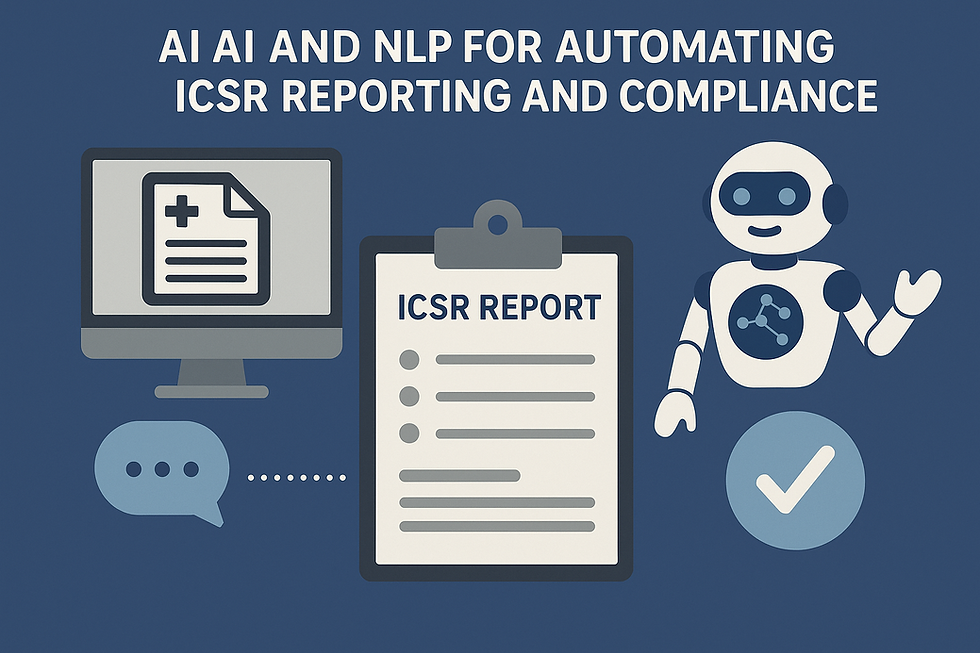
In the realm of pharmacovigilance (PV), timely and accurate reporting of Individual Case Safety Reports (ICSRs) is not just a regulatory requirement—it is a mission-critical activity to ensure patient safety and public trust. As pharmaceutical companies face a surge in case volumes, expanding global regulations, and complex data sources, the need for scalable and intelligent ICSR automation has never been more urgent.
Enter Artificial Intelligence (AI) and Natural Language Processing (NLP)—technologies poised to revolutionize how ICSRs are processed, reviewed, and submitted. By leveraging AI and NLP, organizations can accelerate compliance, reduce manual workload, and elevate the quality of safety data.
In this blog, we’ll explore:
What ICSRs are and why they matter
The role of AI and NLP in automating ICSR workflows
Key benefits and capabilities of ICSR automation
Challenges and regulatory expectations
And how platforms like Tesserblu can streamline the future of pharmacovigilance
What is ICSR Reporting?
An Individual Case Safety Report (ICSR) is a detailed account of an adverse event (AE) experienced by a patient after taking a medicinal product. ICSRs are collected from various sources like:
Spontaneous reports from healthcare providers
Literature
Clinical trials
Post-marketing surveillance
Patient apps and digital touchpoints
These reports are then submitted to health authorities like the FDA, EMA, MHRA, and others via systems like EudraVigilance, FAERS, or VigiBase.
With stricter timelines (e.g., 7-day and 15-day windows for serious adverse events), manual processing of ICSRs is not just inefficient—it poses a compliance risk.
Why AI and NLP for ICSR Reporting?
Traditional ICSR processes involve:
Reading and interpreting source documents (emails, PDFs, call notes)
Extracting relevant data points (e.g., patient info, drug name, event date)
Coding using medical dictionaries like MedDRA or WHO-DD
Entering data into safety databases
Quality review and validation
Electronic submission to regulators
These steps are time-consuming, error-prone, and require highly trained personnel.
AI, especially when powered by NLP, can automate much of this workflow by reading, understanding, extracting, coding, and even validating safety data from unstructured sources at scale.
Capabilities of AI and NLP in ICSR Automation
Let’s break down how AI and NLP transform each stage of the ICSR lifecycle.
1. Source Data Ingestion
Automatically ingest documents from multiple sources: email, fax, web portals, apps
De-duplicate multiple versions of the same case
Use OCR (Optical Character Recognition) to convert scanned images into text
AI Tool Used: Document classifiers, OCR engines like Tesseract or AWS Textract
2. Entity Recognition and Data Extraction
NLP models identify and extract key ICSR fields such as:
Patient demographics
Suspect drug and dosage
Adverse event description
Reporter qualifications
Outcome and seriousness
Techniques Used: Named Entity Recognition (NER), regular expressions, BERT-style models fine-tuned for medical language
3. Medical Coding
Match extracted terms with MedDRA Preferred Terms (PT) and WHO-DD codes
AI can auto-suggest or auto-code based on historical case patterns
AI Tool Used: Rule-based + ML hybrid coders trained on labeled datasets
4. Seriousness and Expectedness Evaluation
AI agents assess:
Is the AE serious or non-serious?
Is it expected based on reference safety info (RSI)?
Does it require expedited reporting?
Tool Used: Decision-tree models, document summarizers
5. Case Narrative Generation
Generate consistent, regulator-ready narratives from extracted data.
Example: “A 58-year-old male patient developed severe nausea and dizziness after initiating treatment with Drug X on 12-Apr-2025…”
Tools Used: GPT-style text generators with fine-tuning on PV narratives
6. Quality Check & Validation
Cross-check for missing fields
Flag inconsistencies (e.g., AE date before treatment start)
Score completeness and suggest corrections
Tool Used: Rule-based validation + predictive anomaly detection models
7. Electronic Submission Preparation
Convert finalized cases into E2B(R3) or other required formats
Ensure field-level validation and XML schema adherence
Upload to regulatory portals (e.g., EudraVigilance)
Benefits of ICSR Automation Using AI & NLP
Faster Turnaround Time
Reduce ICSR cycle time from days to hours, ensuring faster compliance.
Improved Data Accuracy
AI systems reduce human error, improve data standardization, and ensure better coding precision.
Scalable Compliance
Easily handle surges in case volume—like during product launches or safety alerts.
Better Resource Allocation
Free up PV teams from repetitive tasks so they can focus on signal detection and risk evaluation.
Enhanced Auditability
Every AI decision (e.g., why a seriousness was flagged) can be logged and reviewed for transparency.
Example Workflow of an AI-Powered ICSR Automation Pipeline
rustCopyEdit
SOURCE --> AI/NLP ENGINE --> SAFETY DB --> QC MODULE --> E2B XML --> SUBMIT | | | | Email, Fax, Entity Extraction Auto Validation Submission to Call Logs MedDRA Coding & Narratives Regulators
Real-World Use Cases
Case Volume Surge During COVID-19
Pharma companies experienced a spike in AE reports during vaccine rollout. AI-driven ICSR tools helped handle 10x case volume without proportionally increasing headcount.
Literature Monitoring Automation
NLP agents scanned 1000+ journal articles weekly, identified safety-relevant content, and created ICSRs automatically, reducing manual screening time by 85%.
Model Accuracy
Train models on labeled PV data. Fine-tune frequently with expert-reviewed cases. Include human-in-the-loop validation for edge cases.
Explainability
Use explainable AI (XAI) methods to trace how a model decided an AE was serious or how it coded a symptom.
Integration with Existing Systems
Ensure smooth integration with your Argus, ArisG, or Veeva Vault system via robust APIs and middleware connectors.
Regulatory Landscape and AI Readiness
Regulators like EMA and FDA are increasingly open to AI use, provided it meets transparency, traceability, and validation criteria.
EMA encourages AI for efficiency gains but stresses documentation and auditability
FDA has released guidance on AI/ML in drug development and is evaluating similar frameworks for safety systems
Hence, compliance-by-design and proper validation are critical to successful AI deployment in ICSR workflows.
How Tesserblu Can Help
Building and deploying AI models for ICSR reporting is complex—it requires domain knowledge, technical expertise, and scalable infrastructure. That’s where Tesserblu becomes your strategic partner.
Tesserblu's Capabilities for ICSR Automation:
1. Pre-Built AI Models for Pharmacovigilance
NLP engines fine-tuned on thousands of ICSRs
Auto-coding modules for MedDRA and WHO-DD
Entity extractors for 100+ ICSR data points
2. Integrated Case Processing Workflows
Ingest emails, PDFs, scanned reports in real time
Auto-generate E2B-compliant XML for submissions
Interface with safety systems (Argus, ArisG)
3. Compliance-First Design
Full audit trails, explainable AI dashboards
Role-based access, data encryption, and regulatory documentation
4. Rapid Deployment and Scalability
Deployed via cloud, on-prem, or hybrid models
Scales to millions of cases per year with minimal lag
5. Human-in-the-Loop Support
Review flagged anomalies
Provide feedback loops for AI retraining
Custom configuration for different markets or products
Final Thoughts
The future of ICSR reporting lies in automation that is intelligent, scalable, and compliant. AI and NLP are not just buzzwords—they are already transforming how safety teams process cases, respond to regulators, and protect patient lives.
By adopting AI-driven ICSR workflows, organizations can improve efficiency, reduce costs, and stay audit-ready—while enhancing the quality and timeliness of their safety data.
If you're ready to embrace the next generation of pharmacovigilance, Tesserblu provides the technology, compliance expertise, and support you need.
👉 Ready to automate your ICSR processes? Book a free demo with Tesserblu today!


Comments