
Automating Data Entry in Drug Safety Databases: A Game-Changer
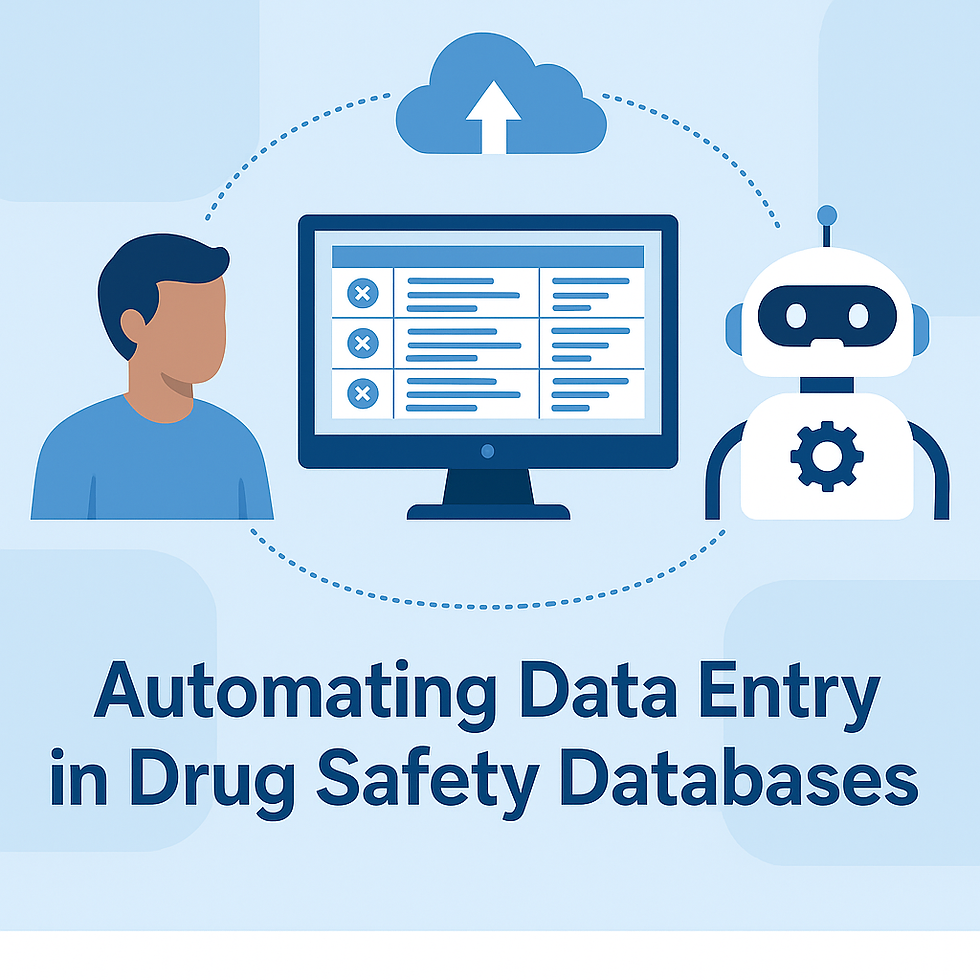
In the ever-evolving world of pharmacovigilance, accuracy, speed, and compliance are paramount. As pharmaceutical companies strive to monitor adverse drug reactions (ADRs), ensure patient safety, and meet global regulatory requirements, data entry into drug safety databases becomes a cornerstone of the entire process. However, traditional data entry methods are often labor-intensive, error-prone, and time-consuming. This is where automation, powered by artificial intelligence (AI), is stepping in as a true game-changer.
Understanding Drug Safety Databases
Drug safety databases are centralized systems where Individual Case Safety Reports (ICSRs) are recorded, tracked, and analyzed. These databases serve as the backbone of pharmacovigilance by enabling companies to:
Collect and store adverse event (AE) data from clinical trials, post-marketing surveillance, and spontaneous reports.
Conduct signal detection and risk-benefit assessments.
Report cases to health authorities like the FDA, EMA, and WHO.
Examples of widely used drug safety databases include Oracle Argus, ARISg, and Veeva Vault Safety. These systems demand precise, timely, and comprehensive data entry to ensure data integrity and regulatory compliance.
The Challenges of Manual Data Entry
Manual data entry in pharmacovigilance is a resource-heavy process. It requires trained professionals to extract, validate, and input data from diverse sources, such as:
Paper or electronic case report forms (CRFs)
Medical records
Literature sources
Call center transcripts
Emails and PDFs
Challenges include:
Time-Consuming Process: Manual case processing can take anywhere from 30 minutes to several hours per case.
Human Error: Even experienced professionals are prone to mistakes, which can lead to inaccurate reporting.
High Operational Costs: Manual workflows necessitate large pharmacovigilance teams.
Inconsistent Data Quality: Variability in human interpretation can affect consistency across entries.
Compliance Risks: Delays or errors in data entry can lead to non-compliance with regulatory timelines (e.g., 15-day reporting for serious unexpected AEs).
The Rise of Automation in Data Entry
Automation technologies, particularly those powered by AI, are transforming how data is entered into drug safety databases. These tools extract, process, and validate data from various sources with minimal human intervention. Key technologies enabling automation include:
Natural Language Processing (NLP): Parses and interprets unstructured text in medical documents.
Optical Character Recognition (OCR): Converts scanned documents into machine-readable text.
Robotic Process Automation (RPA): Automates repetitive tasks such as copying and pasting information.
Machine Learning (ML): Learns from historical data to improve accuracy over time.
Intelligent Document Processing (IDP): Integrates OCR, NLP, and ML to automate end-to-end document handling.
How Automated Data Entry Works
Here’s how AI-driven automation typically operates in drug safety data entry:
Data Ingestion: Automation tools collect data from various input sources like emails, PDFs, EHRs, or call center recordings.
Data Extraction: NLP algorithms identify and extract key data points such as reporter name, patient age, drug name, dose, event date, and narrative.
Data Structuring: Unstructured text is transformed into structured data formats compatible with safety databases.
Validation & Quality Check: The system cross-checks data for completeness and flags inconsistencies or missing fields.
Database Integration: Finalized data is automatically uploaded into the drug safety database (e.g., Argus or ARISg).
Human Oversight: Pharmacovigilance professionals review and validate the entries, ensuring compliance and accuracy.
Benefits of Automating Data Entry in Drug Safety
1. Improved Accuracy
AI algorithms are designed to minimize human error. When trained on large datasets, they can extract key fields with high precision, reducing the likelihood of incorrect entries and missed information.
2. Enhanced Efficiency
Automated tools can process thousands of cases in the time it would take a human team to process a few dozen. This scalability is crucial during peak periods like product launches or safety events.
3. Cost Savings
By reducing reliance on large manual teams, companies can significantly cut labor costs and reinvest in higher-value activities such as signal detection and risk assessment.
4. Faster Regulatory Reporting
Automation ensures quicker turnaround in case processing, enabling organizations to meet strict regulatory deadlines and avoid penalties.
5. Better Compliance
Automated systems come with built-in compliance checks that ensure mandatory fields are completed and timelines are met. Audit trails and validation protocols also make it easier to demonstrate compliance.
6. Consistent Data Quality
AI provides uniform data extraction and entry, leading to more consistent and standardized case records across the database.
7. Empowered Teams
By automating mundane tasks, safety professionals can focus on more strategic functions like trend analysis, benefit-risk evaluations, and regulatory strategy.
Use Cases and Real-World Examples
1. Automated Case Intake
Pharma companies are using AI to automatically read AE reports from emails, extract relevant data, and push it to their safety databases without human touch.
2. Literature Monitoring
AI tools scan scientific journals, identify case reports, extract necessary data, and populate databases accordingly—often with over 95% accuracy.
3. Call Center Transcripts
Voice-to-text tools convert AE-related phone calls into transcripts, and NLP systems extract and input critical information directly into drug safety systems.
4. EHR Integration
Some companies are integrating AI with electronic health records (EHRs) to automatically identify and report adverse events in near real-time.
Key Considerations for Implementation
While the benefits of automation are clear, successful implementation requires thoughtful planning. Key considerations include:
1. Data Privacy & Security
Pharmacovigilance data often contains sensitive patient information. Automation solutions must comply with HIPAA, GDPR, and other local data protection laws.
2. Integration with CTMS and Safety Systems
Automation tools must be compatible with existing Clinical Trial Management Systems (CTMS), EDC platforms, and safety databases.
3. Training & Change Management
Teams must be trained to work with AI tools, understand outputs, and validate results. Change management is essential to ensure smooth adoption.
4. Validation and Compliance
All automated systems must be validated according to GxP standards. Companies need to document algorithms, version changes, and testing procedures.
5. Human Oversight
Even with automation, human oversight remains critical for quality assurance and case finalization, especially for serious or complex cases.
The Future: Toward Fully Intelligent Safety Systems
As AI and automation technologies mature, the future may hold fully autonomous safety systems that can:
Detect new safety signals through real-time monitoring
Automatically determine causality and seriousness
Proactively flag compliance risks
Assist in preparing Periodic Safety Update Reports (PSURs) and Development Safety Update Reports (DSURs)
These intelligent pharmacovigilance ecosystems will not only enhance compliance but also contribute to proactive, predictive, and personalized drug safety management.
Conclusion
Automating data entry in drug safety databases represents a pivotal shift in pharmacovigilance practices. By harnessing AI, pharmaceutical companies can reduce human error, accelerate case processing, ensure regulatory compliance, and ultimately improve patient safety. As the industry embraces digital transformation, automation isn’t just an option—it’s a strategic imperative. Organizations that adopt and integrate AI-driven data entry solutions today will be better equipped to navigate the regulatory landscape of tomorrow.


Comments