
Case Study: Improving Literature Review Efficiency by 40% with Intelligent Automation

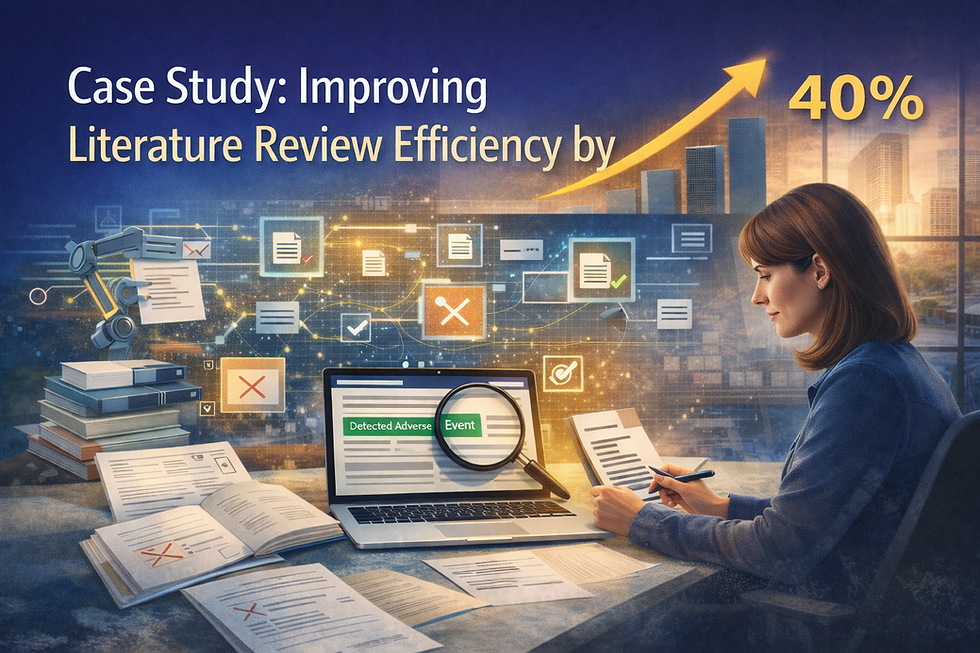
Pharmacovigilance teams today face a growing challenge. The volume of scientific literature is increasing rapidly, regulatory expectations are becoming stricter, and safety teams must process large amounts of information while maintaining accuracy and compliance. Traditional manual literature review methods, once considered sufficient, are now struggling to keep up with the scale and complexity of modern pharmacovigilance operations.
This is where advanced technology platforms such as Tesserblu are beginning to transform how safety teams operate. By combining artificial intelligence, natural language processing, and intelligent workflow automation, Tesserblu helps organizations streamline literature screening, reduce manual workload, and improve efficiency without compromising regulatory compliance.
This blog explores a realistic case study scenario in which a pharmacovigilance team improved literature review efficiency by nearly 40% after implementing an AI-driven literature monitoring solution powered by Tesserblu. The transformation highlights how technology can modernize pharmacovigilance workflows while strengthening compliance and operational scalability.
The Growing Burden of Literature Monitoring
Scientific publications have grown dramatically over the past decade. Every day, thousands of new journal articles, case reports, clinical studies, and conference abstracts are published across the world. For pharmaceutical and biotech companies, many of these publications may contain potential adverse events or safety insights related to their products.
Regulatory authorities such as the FDA and EMA require marketing authorization holders to conduct systematic literature monitoring to identify adverse events reported in the public domain. These cases must be evaluated and reported according to strict regulatory timelines.
For safety teams managing multiple products, the task quickly becomes overwhelming. Even a moderately sized portfolio may require screening thousands of abstracts every week. Many of these articles are irrelevant, yet they still require manual review to confirm whether safety information is present.
This growing workload creates operational strain. Reviewers spend a significant portion of their time filtering irrelevant articles rather than focusing on meaningful safety evaluation.
The Challenge: Manual Processes and Operational Inefficiency
Before implementing automation, the pharmacovigilance team in this case study relied on a traditional literature review process. Weekly searches were conducted across several literature databases using predefined keyword strategies. The results were exported into spreadsheets where safety reviewers manually screened titles and abstracts.
Although the process met regulatory requirements, it was far from efficient. A large percentage of articles flagged by keyword searches were false positives. Reviewers spent hours evaluating articles that ultimately contained no relevant safety information.
In addition, the documentation process required reviewers to manually record screening decisions and justification notes. This increased the administrative burden and made it difficult to maintain consistent documentation across reviewers.
As literature volumes continued to grow, the team began experiencing screening backlogs. This created pressure on timelines and increased the risk of delayed case identification.
Leadership realized that the existing process would not scale as the product portfolio expanded.
Exploring AI-Powered Literature Monitoring
To address these challenges, the organization began evaluating AI-driven pharmacovigilance solutions capable of automating literature screening while maintaining compliance with regulatory expectations.
After reviewing several options, the team implemented Tesserblu, a platform designed specifically for pharmacovigilance automation. Tesserblu’s intelligent literature monitoring capabilities offered a combination of natural language processing, contextual screening, and automated workflow management.
Unlike traditional keyword-based filtering, Tesserblu’s NLP technology analyzes the meaning and context of scientific text. This allows the system to understand whether an article truly contains safety-relevant information rather than simply matching keywords.
The goal of implementing Tesserblu was not to replace safety experts but to augment their capabilities by removing repetitive screening tasks and allowing them to focus on higher-value evaluation.
Implementation and Workflow Transformation
The implementation process involved integrating the organization’s existing literature sources into Tesserblu’s monitoring system. Search strategies were configured within the platform, ensuring alignment with regulatory expectations and internal pharmacovigilance procedures.
Once operational, Tesserblu began automatically ingesting literature search results and applying AI-driven screening to identify potentially relevant articles. The platform prioritized articles most likely to contain adverse event information while filtering out obvious false positives.
Safety reviewers now received a curated list of prioritized articles instead of reviewing every search result manually. This significantly reduced the time required for initial screening.
In addition, the platform captured screening decisions within a structured workflow. Each action, reviewer decision, and timestamp was automatically documented, creating a consistent audit trail.
This new workflow streamlined both operational efficiency and compliance documentation.
Achieving a 40% Efficiency Improvement
Within the first few months of deployment, the organization began measuring the operational impact of the new system. The results were significant.
The AI-powered screening capabilities within Tesserblu dramatically reduced the number of irrelevant articles reaching human reviewers. Safety professionals were able to focus their attention on the most relevant literature rather than performing repetitive filtering tasks.
As a result, the team experienced approximately a 40% improvement in literature review efficiency. The same number of reviewers could now process substantially larger volumes of literature without increasing workload.
Screening backlogs were eliminated, and review timelines became more predictable. This improvement also reduced stress within the team, allowing reviewers to focus more deeply on safety evaluation rather than administrative tasks.
Enhancing Quality and Consistency
Efficiency gains were not the only benefit. The implementation of Tesserblu also improved the consistency of screening decisions.
Manual screening processes often vary between reviewers due to differences in interpretation or experience levels. By applying consistent AI-driven prioritization, Tesserblu created a standardized initial screening layer across the entire workflow.
Reviewers continued to validate final decisions, but the AI-assisted approach reduced variability in article prioritization. This consistency improved overall quality and strengthened the organization’s confidence in its literature surveillance process.
Additionally, structured documentation within the platform ensured that screening decisions were clearly recorded and easily retrievable.
Strengthening Inspection Readiness
Regulatory inspections frequently evaluate literature monitoring processes to ensure compliance with pharmacovigilance requirements. Inspectors may request evidence demonstrating that searches were conducted systematically and that screening decisions were properly documented.
Before implementing Tesserblu, compiling inspection documentation required gathering records from multiple spreadsheets and reviewer notes. This process was time-consuming and prone to inconsistencies.
With Tesserblu, documentation became centralized and standardized. Audit trails were automatically generated for each screening action, including timestamps, reviewer comments, and workflow status updates.
During internal quality reviews, the organization found that preparing documentation for inspections became significantly easier. The system provided clear visibility into the entire literature monitoring process.
This increased transparency strengthened regulatory confidence and reduced compliance risk.
Enabling Scalable Pharmacovigilance Operations
As the organization expanded its product portfolio, the scalability benefits of Tesserblu became increasingly apparent.
Traditional manual processes require additional reviewers as literature volumes grow. However, with AI-assisted screening, the team was able to absorb higher workloads without proportionally increasing staffing levels.
Tesserblu’s automation capabilities allowed the organization to scale operations efficiently while maintaining consistent quality standards. This scalability was particularly valuable as the company prepared to launch additional products in new therapeutic areas.
The technology effectively future-proofed the organization’s literature monitoring capabilities.
Empowering Safety Professionals with Intelligent Tools
One important lesson from this case study is that AI does not replace pharmacovigilance expertise. Instead, it enhances the effectiveness of safety professionals.
By automating repetitive screening tasks, Tesserblu allows reviewers to dedicate more time to complex safety evaluation and signal detection. Their expertise becomes focused on high-impact decision-making rather than routine filtering.
This shift elevates the role of pharmacovigilance professionals, enabling them to contribute more strategically to patient safety and risk management.
Conclusion: Transforming Literature Review with Tesserblu
The pharmacovigilance landscape is evolving rapidly. Increasing literature volumes and rising regulatory expectations require organizations to rethink traditional manual workflows.
This case study demonstrates how AI-driven platforms like Tesserblu can significantly improve operational efficiency while maintaining regulatory compliance. By leveraging intelligent screening, natural language processing, and automated documentation, Tesserblu enabled a pharmacovigilance team to improve literature review efficiency by 40%.
Beyond efficiency gains, the platform strengthened documentation consistency, improved inspection readiness, and created a scalable foundation for future growth.
As pharmacovigilance continues to evolve, organizations that embrace intelligent automation will be better positioned to manage complexity, protect patient safety, and maintain regulatory confidence. With solutions like Tesserblu, literature monitoring is no longer just a compliance task—it becomes a streamlined, data-driven process that empowers safety teams to operate at their full potential. Book a meeting if you are interested to discuss more.


Comments